Showing posts with label Moses. Show all posts

Sunday, January 15, 2012

Heaven's True Gate

 Texts:    Genesis 28:10-17; John 1:43-51

    WITHIN EVERY HUMAN BEING rises the question, "How do I get to heaven?"  "Heaven" means different things to different people.  For one man, "heaven" might mean eternal unity with the Uncreated Source of all majesty and bliss.  For another, "heaven" could mean having a belly full of good food for now and the foreseeable future.  Some say heaven is a state we enter after this physical life is over; others say it'll come about on this earth when social justice and equal prosperity are granted to all.

    But one thing is common: when we human creatures ask the question, "How do I get to heaven?" we mean, "What do I have to do to get there?"  What good work must I perform, what god must I appease, what pleasure must I give up, what plan must I follow, what cause must I join, what gate must I locate and go through, what ladder must I climb, what must I do to get to heaven?

    But our readings from Holy Scripture turn this common human assumption on its head.  The whole of Scripture teaches us that the principle of us getting into heaven by our own efforts is junk, like a bad GPS that'll send us down a dead-end road.  No, the key to heaven is found in Jesus' statement in John 1:51: "I tell you the truth, you shall see the heaven open, and the angels of God ascending and descending on the Son of Man."

    But how do we use this key?  What is Jesus talking about?

    Jesus is talking about the ladder or stairway seen in a dream by the patriarch Jacob in ancient times, as we read in our passage from Genesis.  As we look at that passage and then link it to what is happening in our reading from St. John, let's ask ourselves: Is it our job to get ourselves into heaven, or does the effort and initiative all belong to God?

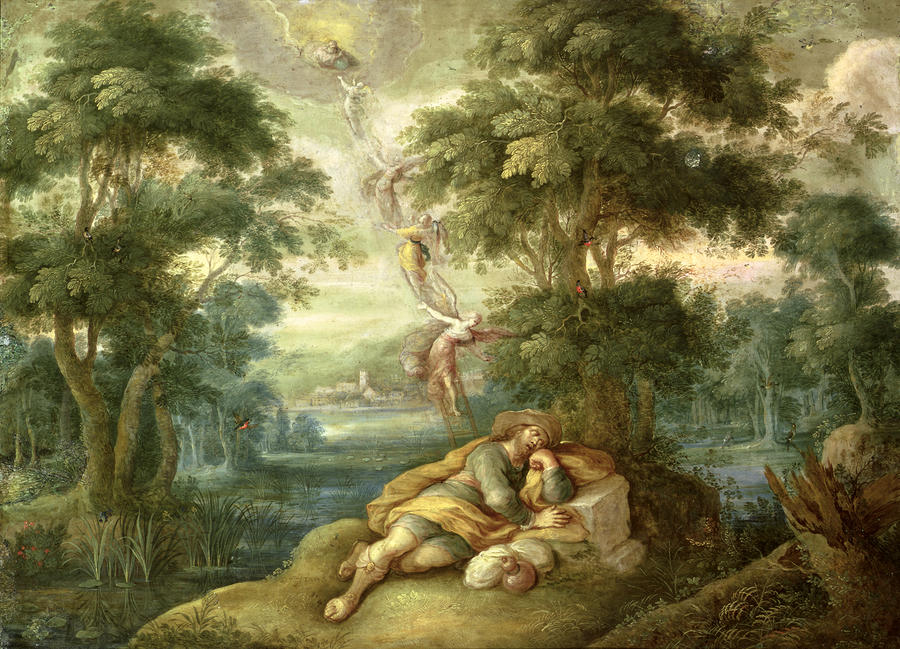
    In Genesis chapter 28 Jacob son of Isaac is headed to his uncle Laban's in Haran, in Syria.  Officially he's leaving Canaan to find himself a bride among his cousins there.  The real reason is that he's pulled a low-down, sneaky trick and cheated his older twin brother Esau out of the family birthright.  After a day's journey he camps out under the stars, using a stone for a pillow.  And there Jacob has a dream.  Not just any dream, but a true dream, a vision, actually, given to him directly from the Lord, the God of his father Isaac and his grandfather Abraham. 

    In his dream, Jacob saw a great stairway or ladder with its foot rested on the earth near where he lay.  Its head reached up to heaven.  On this stairway the angels of God were going up and down, pursuing their business between heaven and earth. 

    The Bible tells us in various places about the business of angels.  In the Gospel of Luke and elsewhere they are God's messengers, bringing His commands to His people.  They're ministering spirits, according to the Letter to the Hebrews, appointed to serve those who will inherit salvation.  St. Paul writing to the Galatians tells us that angels assisted some way when God gave the Law to Moses on Mount Sinai.  In Revelation we read  how angels will be God's agents in carrying out His judgment on the sinful earth.  And always and at all times, the angels of God praise Him and give Him glory.  By their activity we see the Lord God's activity and involvement in this world, never ceasing, continually going to and fro, carrying out His plans for creation.

    Jacob saw all this in his dream, but he saw more.  Above the stairway or ladder--above it, notice, not merely at the top of it-- Jacob could perceive a Being that he knew was the Lord God Almighty.  But Jacob doesn't recognize the Lord by His appearance, any more than we do.  He knew Him by His word.  The Lord said, "I am the Lord, the God of your father Abraham and the God of Isaac."  The Lord repeats to Jacob the covenant promises He made and confirmed to Abraham.  But now the Lord grants and applies the covenant promises to him, Jacob.  Jacob, the deceiver, the cheater, the sneak.  The one who deserved nothing from God's hand but judgment and could do nothing to earn His favor.  He wasn't even Isaac's firstborn son!  Out of the Lord's free grace it is Jacob and his descendants who will inherit the land.  His descendants will be like the dust of the earth.  It is through him that all the peoples on earth shall be blessed. 

    Jacob awakes, and he knows he has dreamed true.  He has seen the Lord Almighty standing in heaven above the top of the ladder of the angels.  But now he says, "Surely the Lord is in this place, and I was not aware of it."  The Lord is in heaven, and He is here on the earth below.  He is present with us whether we're searching for Him or not, even when we're totally unaware of His presence.

    Jacob is now awake in more ways than one.  His eyes have been opened.  God has chosen to reveal Himself to him, and he exclaims, "How awesome is this place!"

    It's really too bad that the word "awesome" is so worn out by slang use these days.  What word can we use to express the combination of fear, joy, wonder, and reverence that surely flooded through Jacob at that time?  He says, "This is none other than the house of God; this is the gate of heaven."  Right there in that barren, lonely place, near a village too small even to have a caravan stop, that was the house where God was to be worshipped.  That was the gate through which the Lord had come down and called an unworthy man like Jacob into covenant life with Him.

    The life of the covenant is central to the revelation Jacob receives at Bethel.  Over the years and centuries since then, God revealed to His prophets that the covenant blessings would be focussed in and brought to reality by the Anointed One, the Christ.  The hope and cry of God's people was that soon the King, the Son of David, would come.  He would reclaim the land; He'd grant life and hope to the descendants of Jacob; He'd be the One through whom all nations would be blessed.

    And in God's good time, John the Baptist appeared, preaching that people should repent for the time of the Messiah was soon.  So be baptised!  Get ready!  Finally, one day, Jesus from Nazareth came to be baptised.   The time had come!  John recognized Him and declared,  "Behold, the Lamb of God who takes away the sins of the world!"  He tells two of his disciples, Andrew and probably Philip, that Jesus is the One Israel has been waiting for.  Immediately they approach Jesus to spend time with Him to find out more about Him.  We see in John 1:41 that they are convinced that John has spoken truly, for Andrew brings his brother Simon to Jesus, saying, "We have found the Messiah!"

    All this takes place in Judea, east of Jerusalem on the other side of the Jordan River.  The next day, as we pick up our Gospel reading, Jesus has decided to go back to Galilee.  Before He goes, He extends a special invitation to Philip to be His permanent disciple:  "Follow Me!" Jesus commands.

    Why does Jesus call Philip in particular?  Maybe because of what Philip does next.  In his excitement, he seeks out a friend of his, a man named Nathanael.  Before he leaves for the north he wants Nathanael to hear the good news.  "We have found the one Moses wrote about in the Law, the one the prophets wrote about!"

    Imagine Nathanael's wonder and hope when he heard this!  Most likely he, too, was a disciple of John, not on the scene when Jesus was baptised, but now how joyful he would be at hearing this good news!

    And how disappointed he must have felt when Philip told him the Messiah was from Nazareth.

    Nazareth?  That hick town?  That barren place half-overrun with Gentiles?  What good could come out of Nazareth?  He's like Jacob outside of Bethel, aware only of the stones and the hardness of the ground.  Nathanael may be looking for the Messiah, but certainly not there.

    But Philip isn't deterred.  "Come and see!" he says.

    When Jesus sees Nathanael coming, He exclaims, "Here is a true Israelite, in whom there is nothing false!"

    What a reversal!  Deceitful Jacob was the original Israelite, you might say.  But God was forging a new Israel, a true Israel, who would deal openly and without guile.  And such a one was this Nathanael.

    This stranger from Nazareth has him pegged.  It's possible Nathanael prided himself on his honesty and straightforwardness.  In a land and a time when it was safer to play things close to the vest, this quality was unusual, and he's amazed that Jesus recognizes it in him before He can actually look him in the face.  "How do you know me?" he asks.

    "I saw you while you were still under the fig tree before Philip called you."

    We've all heard of so-called clairvoyants and psychics who claim to be able to see from afar.  But Nathanael knows that the true ability to see into men's hearts, the real far-seeing where the spirit of a man can go with another and see what he is doing belongs only to a great prophet of God, like Elisha in ancient times.  So Nathanael draws his immediate and forthright conclusion: "Rabbi, you are the Son of God, you are the King of Israel."

    Could he have said such a thing unless God had revealed it to him?  Not at all, no more than Peter later on could confess Jesus as Lord on his own initiative.  It is God's revelation and doing.  Nathanael recognises the presence of God in that place; that is, in the person of Jesus of Nazareth, and he does so because the Lord God has granted it. 

    Jesus accepts Nathanael's perception of Him, but He knows very well that the man's eyes aren't fully opened as yet.  Nathanael, as well as Philip, Simon Peter, and Andrew, still has a limited grasp of Jesus' identity as the Messiah, the Son of God and the King of Israel.  Angels were called sons of God; kings were referred to as sons of God; prophets, priests, and kings were all anointed ones: how could a Man born of woman, let alone a Man from Nazareth, be the Son of God in the most literal and fundamental way?

    But this is what Jesus promises to reveal Himself to be.  He tells Nathanael and the others that "you," plural, "will see the angels of God ascending and descending on the Son of Man."  They will come to realize that it is by Him that the angels pursue their ministry of command, comfort, and judgment.  Jesus and Jesus alone will show Himself to be Immanuel, God with us, exalted in the heavens yet present with us on earth.  He will be revealed as the one Mediator between heaven and earth and heaven's true gate.

    Human beings of all religions and no religion at all are eager to make it into some kind of heaven.  But the God of Abraham, Isaac, and Jacob reveals by His word that heaven is where He is, where He rules and reigns in His glory amidst angels and archangels.  It is a state that He offers to us through Jesus Christ, not one that we can earn.  It is all God's doing, offered to us through His sovereign grace in Christ Jesus.  He gives us even the faith to see and believe and the will to persevere.

    But the desire to exert our human will and effort dies hard. Even as Christians, we don't fully understand that it all depends on God.  Think of the song "We Are Climbing Jacob's Ladder."  It's in this hymnal.  But we aren't called upon to climb Jacob's ladder, at least not by our good works and service, for Christ Himself has come down to us.  And despite what it says in the Led Zeppelin song, no one can buy the stairway to heaven.  No, the gift of God in Jesus Christ is given to us freely.  He paid our admission to the presence of God by His death on the cross and brought us to the life of heaven by His resurrection. 

      Hear what St. Paul writes in his letter to the Romans.  He is quoting Moses: 

    "Do not say in your heart, ‘Who will ascend into heaven?'" (that is, to bring Christ down)  "or ‘Who will descend into the deep?'" (that is, to bring Christ up from the dead). But what does it say? "The word is near you; it is in your mouth and in your heart," that is, the word of faith we are proclaiming:  That if you confess with your mouth, "Jesus is Lord," and believe in your heart that God raised him from the dead, you will be saved.

    The Lord God is present in Jesus Christ, and there are many in this world who are not aware of it. But to you it is given to know and to see who He is and what He has done for you.  Receive the gift of eternal life through Jesus Christ your Lord, and worship Him and serve Him in loving gratitude.  For He is the eternal house where we meet and enjoy God, He is the true gathe of heaven.

Sunday, September 4, 2011

The Greatness of Humility

Texts:    Exodus 32:7-14     Matthew 18:1-10

    IT'S GREAT TO BE GREAT.  ABOUT ten years ago BBC television in the UK and PBS here in America produced several programs, all testing the question, "How well could modern people cope if they had to go back in time and live as their ancestors did?"  Ordinary people were selected to live for months in an historically-authentic, isolated environment where the only modern things were the film cameras.  Barring emergencies, the participants had to survive with only the tools, clothes, diet, and social relations used by the people of the long-ago time.  

    Recently I found these programs posted on YouTube, and I started watching a series called Edwardian Manor House.  But before I'd even gotten through the first episode, I couldn't help but feel upset.  As a 21st century American I found it hard to stomach the idea of everyone being kept strictly in their place and the people at the bottom having to be humble whether they wanted to be or not.  On the BBC website they interviewed the participants after the filming was over, and as you can imagine, those who'd been the "servants" were glad to get back to the freedom of 21st century Britain.  But the family who got to act as the family of an Edwardian baronet?  Not surprisingly, most of them wished they could have stayed in 1905 forever.  After all, it's great to be great.

    In our reading from the Gospel according to St. Matthew, the disciples come to Jesus "at that time" and asked, "Who is the greatest in the kingdom of heaven?"  At what time?  Well, at the end of chapter 17 the collectors of the temple tax came to Peter on the street in Capernaum and asked whether Jesus paid it.  Peter said Jesus did, but when he came into the house where Jesus was, our Lord spoke first and taught him that by rights, He and His disciples didn't have to pay.  After all, they were sons of the kingdom, sons of God the heavenly King, and in those days, kings never collected taxes from their own families.

    So here are the disciples, and Jesus has just included them as sons of the kingdom of heaven.  Well!  It was also the custom, even up to a century or two ago, for kings to give the best jobs in the kingdom to members of their families.  So the disciples are thinking, "Hey, we're sons of the kingdom: Jesus must have some really high positions waiting for us when He comes into His own.  But who's going to be His prime minister?  Who will be the greatest?"  If you were one of them, wouldn't you want to know?

    In response, Jesus gives them a visual parable.  He calls in a little child and has the boy stand where they all could see him.  And he says, "I tell you the truth, unless you change and become like little children, you will never enter the kingdom of heaven.  Therefore, whoever humbles himself like this child is the greatest in the kingdom of heaven."

    It's popular these days for us to impose our modern view of children on this episode and miss what Jesus is saying.  We're all guilty of it, including me.  We say, "Oh, Jesus is saying we have to be innocent like a little child."  But a 1st century Jew, especially a Jew who was also the Son of God, would never imply that children were born innocent.  All of us are born in trespasses and sins, all of us stand guilty before God.  And in case you don't believe me, watch a two-year-old having a temper tantrum.  Or we say, "Children don't care about position and advancement."  Oh really?  Just observe a toddler who's been supplanted by a new brother or sister, and you'll see just how heedless of position kids are.  (Not hardly!)  Or we think Jesus is referring to how teachable children are.  Well, I substitute teach, and some kids take in knowledge readily, but a lot of them rebel and don't want to hear about it.  And absolutely, Jesus doesn't expect any one of us to go around talking ourselves down and talking about being "A worthless worm."  What normal child ever did that?  No, Jesus was telling His disciples and us that in the kingdom of heaven; that is, in the sight of God in His church, we must take a position like that of an insignificant little child.

    Maybe if you come from an old-school family where children were seen and not heard, you might be able to conceive of the radical upheaval this statement of Jesus must have produced.  It was like telling the lady of the house to take the role of the scullery maid, or the master of the house to do the job of the slave who washed everyone's feet.  Children, especially little children, simply had no say or authority in 1st century Jewish society.  In a great household even the adult slaves bossed them around.  And Jesus says we must humble ourselves to that extent, if we want to be great in the kingdom of heaven.

    And not only do we have to be humble like little children to have any greatness in the kingdom of heaven, Jesus says we have to change-- to deny ourselves-- and become like children even to enter God's kingdom in the first place.

    We can fight against it all we want, but it's true:  We cannot believe in Jesus for salvation until we admit that we have nothing to offer God in return for His mercy, there's nothing in us that could attract God's favor; that as we are in our sins, to God we are obligations and not assets.  As with children, we have to realize that everything we have from our heavenly Father is a gift that we did not and could not earn.  We are helpless in our sins, we can't even be properly humble! until Jesus Christ reaches down to us in love and adopts us and makes us great in Him.

    This need for childlike humility applies to all believers, to the disciples, to you, to me.  But what about those who actually are children?  Does Jesus just use the kid as an illustration then send him away?  Can we?  No!   In verse 5 He goes on to say, "And whoever welcomes a little child like this in my name welcomes me."

    Did you get that?  Jesus Christ the Son of God identifies with the child, the low, the insignificant, the humble.  This was not just cheap talk from our divine Master.  In Philippians chapter 2 we see how He put His words to work.  There it says that He was

    . . . in very nature God, [but he]
               did not consider equality with God something to be grasped,
    but made himself nothing,
          taking the very nature of a servant,
           being made in human likeness.
    And being found in appearance as a man,
           he humbled himself
       and became obedient to death—
        even death on a cross!

    "Even death on a cross."  When we receive a little child in His name we welcome our crucified and risen Lord, and when we welcome our crucified and risen Lord, His humility for us should remind us to welcome and look out not only for young children, but for all who are the humblest of the humble and the lowest of the low, the little ones of His kingdom.  Because it's not about us anymore.  It's about Jesus Christ and each other in Him.  If you and I will focus on seeing and honoring Him in one another, Jesus knows that will go a long way towards keeping us from hurting and harming one another.

    For our Lord knows what's in us.  He knows that even in His church it's hard for us to keep on finding our greatness in Christian humility.  It's difficult to keep on weighing our actions and words in light of the good or bad effect they might have on  the little ones of the body, whether they're children in years or those who are young in the faith.  Even in God's congregation there will be people and actions that put stumbling blocks in the way of the humble. 

    The phrase in verse 6 that the New International Version translates "cause . . . to sin" is the Greek word σκανδαλίση [skandaliseh]-- the word we get  "scandalize" from-- and it literally means to trip someone up by putting a stumbling block in their way.  To quote R. T. France, one of my teachers in theological college, "One can be ‘tripped up' as much by a disparaging attitude, a lack of concern and pastoral care, or a refusal to forgive, as by a ‘temptation to sin.'" The ultimate evil in "scandalizing" a fellow-member would be that it turned him or her away from Christ and His salvation, or at least to made his or her Christian journey a trial rather than a joy.

    But what can we say?  All of us do or say insensitive or unhelpful things to one another out of sheer carelessness, and here Jesus says that anyone who trips up the young and humble in the church may as well have a humongous millstone hung around his neck and be drowned in the depths of the sea.  How can we avoid such sin and its condemnation?

    We must return to what Jesus has already said: Whoever wants to be greatest in the kingdom of heaven must humble himself and become like a little child.  When we're looking out for others' welfare we'll have a lot less time to be asserting ourselves and putting stumbling blocks in each others' way!

    And it isn't like we can watch out for the spiritual welfare of children and new converts, but go ahead and hurt and harm those who are older or who have been believers longer.  Jesus shows us in verse 7 that He wants us to be careful for all the members of the church.  In this fallen world it's inevitable, Jesus says, that skandalon-- stumbling blocks-- should come, but woe to the one through whom they come!  The way of the world must not be the way of the Church of Jesus Christ.  No, we who are His disciples should be so anxious for our mutual growth in Christ that if our hand or foot causes us or anyone else to stumble-- same word skandalizei again-- we should cut it off.

     Jesus is speaking in hyperbole, but does that mean we can disregard what He says?  No.  He intends to convince us of how deeply we must humble and deny ourselves for His sake and for the sake of our salvation.  There's nothing more important on earth than to persevere in faith in Jesus Christ and at last through Him to attain to the resurrection of the dead.  So if there's anything in your life, any sin, any habit, any ungodly relationship that harms others and separates you from Him, end it, cut it off.  If there is any attitude in you or me, any way of thinking or being that says, "I'm the greatest, I'm going to do things my way, and God and everybody else had better just give me room," end it, cut it off.  Even if you had to go through eternity maimed, that would be better than to depart from the way of Christ and go into the fires of hell with your self-image and pride intact.

    So does humbling ourselves means exercising no power or authority at all?  The story of Moses disproves that idea.  In Numbers 12:3 it says, "Now Moses was a very humble man, more humble than anyone else on the face of the earth."  We see Moses' humility in our reading from Exodus 32.  When the Israelites sinned by making and worshipping the golden calf, God offered to destroy them and make of Moses a great nation, a replacement chosen people.  But in his humility Moses sought the Lord's mercy for the Israelites.  He admitted their sin and appealed to the Lord's promise to Abraham, Isaac, and Jacob.  Moses was the leader of the Israelites, but he claimed nothing for himself.  Rather, he sought the good of the people, even in the depth of their sin.

    Whether we have major responsibilities in the church or simply faithfully attend, Jesus calls you and me to carry out our duties for the good of one another and to the glory of God.  As Paul writes, again in Philippians 2, we should "do nothing out of selfish ambition or vain conceit, but in humility consider others better than yourselves."  In the end, if all of us strive to outdo one another in humility, encouragement, tender-heartedness, and love, none of us should ever have cause to complain that we're being oppressed or that others in the church are lording it over us. 

    And if we ever should think that Jesus doesn't understand how difficult being humble can be, let us look again to the cross where He died to take the penalty for our sins.  When Jesus calls us to find our greatness in humility, He is calling us to find our greatness in Him, the One who came not to be served, but to serve and to give His life as a ransom for many.  Jesus says, "Take my yoke upon you and learn from me, for I am gentle and humble in heart, and you will find rest for your souls." It's great to be great, and in the kingdom of heaven, true greatness is found only in the humility of our Lord and Savior Jesus Christ, to whom by all wisdom, honor, and glory.  Amen.

Sunday, March 22, 2009

What Love Looks Like

Texts: Numbers 21:21:4-9; John 3:14-21

WHAT DOES SIN LOOK like? What does Love look like? More to the point, what does Love look like, the kind of Love with the power to overcome sin?

Our modern culture is sure it knows what love looks like. Love is always nice and caring and therapeutic. It never, ever, gives offense. It never tells anyone he’s wrong or implies that anyone is headed in the wrong direction. Love never says No. What really matters in love is that each person’s wants and desires and yearnings should be indulged and gratified. And if anything gets in the way of that gratification, including any law of God or man, it should be ignored or struck down.

That’s how our culture sees love. But can that love overcome sin?

I suppose that depends on our picture of "sin." In our world today, sin is usually seen as "brokenness" or "disease." It’s not anything we did or do or are, it’s something that’s been done to us. So that even if we end up hurting others or ourselves, that’s not really our fault. We’re gripped by an addiction! We’re suffering from an emotional disease! Something outside ourselves makes us do antisocial things and we just can’t help it.

Maybe the indulgent, therapeutic kind of love can deal with this kind of "sin." It "deals" with it by overlooking it and minimizing it and curing it. It says, "What you did isn’t so bad and you’re okay just the way you are!" It says, "You’re a victim and with our help you won’t have to face anything bad or difficult, ever again!"

These pictures of sin and love are widespread in our culture. So widespread, in fact, that you may be thinking, "Yes, love is the opposite of being judgmental! And sin really is nothing but brokenness, and we need therapy and healing, not condemnation!" And in our human relations, certainly there are times when judgment must be reserved. Certainly, there are occasions when the sinfulness of this world system gets hold of a person, and he or she absolutely needs to get psychological help in order to get free of that phobia or neurosis or whatever, before he or she can do what is right and good.

But for most of us most of the time, it’s convenient to see love as indulgent and sin as something we can’t help, because it vindicates us as good, okay people.

It works wonderfully-- until we look at the God-Man Jesus Christ, and gaze upon His understanding of sin, and see the kind of love it took to overcome sin. Then our blindness is stripped away and we see the enormity of our offenses, and how great and awesome is the love of God that defeated it for our sakes.

What does sin look like, according to our holy God? In John Chapter 3 the Jewish ruling council member Nicodemus has come to Jesus by night to learn more about this wonder-worker from Galilee. Jesus immediately comes to the point of His ministry on earth: To bring new, eternal life to dead, lost sinners, so they might enter the kingdom of God.

But Nicodemus doesn’t get it. He misunderstands what Jesus means about being born again. And when Jesus uses the example of the wind to show how the Holy Spirit can do whatever He wants without human help, Nicodemus replies, "How can this be?" So in His mercy our Lord gives him a picture of human sin and divine love that he surely cannot misread, an example from Israel’s history that surely Nicodemus has known from his youth. Jesus says to him, "Just as Moses lifted up the snake in the desert, so the Son of Man [that is, Jesus Himself] must be lifted up, that everyone who believes in him may have eternal life."

So we look at our reading from Numbers, and we think, Hey, what the Israelites did doesn’t seem that bad. We’d complain, too, if we’d been tromping around a desert for forty years eating the same old manna and never knowing where our next drink of water was coming from! Wasn’t the Lord a little, well, cruel in putting His people to death for such a small offense?

But when we defend them and prosecute God we prove that we, too, are guilty of the same sin. Think who these people were! Think who this God was, that they were blaspheming against! They were the children of the Lord’s promise. He was and is the Lord of heaven and earth, who’d rescued them with power from the overwhelming might of Egypt. He’d fed them miraculously with the bread of angels, as it says in Psalm 78. He provided them with all the water they needed! He gave them victory over every army that marched out to block their way! Year after year after year they’d seen that the Lord God of Israel could be depended on totally. When they complained on the way around Edom, they weren’t just speaking against Moses and their living conditions, they were speaking against the Lord Himself! And we are exactly the same, when we exalt our desires and fears up against the faithfulness of God.

The Lord sent our spiritual ancestors a punishment that was a picture of sin itself. What does sin looks like? It looks like snakes that bite us so we die. Sin is hissing, insidious, and sneaky, and it fills us with the fire of death. The Hebrew word translated "venomous" actually means fiery, and I’m afraid that by using the familiar term our modern translation has lost us something.

Ancient writers spoke of a little red serpent called the "dipsas," whose name means "thirst." It could bite a man without being felt, but its venom would engender a raging, burning thirst that made the bitten one run mad and commit any crime or dishonor to slake it. All the time the victim would think it was thirst alone that was the problem, but drinking all the rivers of the world dry could not keep him from fiery death.

That’s a picture of sin. We think our problem is something outside ourselves, something we desire, and if we can get it we’ll be all right. But the venom of sin is in us, working through all our members and taking us down to death.

Whether the fiery serpents in question were the dipsas or some other kind of poisonous snake, they were a perfect image of the Israelites’ sin.

But Israel in the desert couldn’t pretend it was mere hunger and thirst that was killing them. They couldn’t even pretend it was the fiery serpents themselves, as if death would stop if God would be more "loving" and take the snakes away. They faced the fact that it was their own sin they were dying of. They repented and said to Moses, "We sinned when we spoke against the Lord and against you. Pray that the Lord will take the snakes away from us."

So Moses prayed for the people. But it’s striking: Numbers does not tell us that the Lord took the snakes away, at least, not at that time. Something crucial had to happen first.

The Lord commanded Moses to make a model of one of the snakes and transfix it on a tall pole and set it up where the people could see it. Moses made it out of bronze, and if you’ve ever seen new bronze, you know it’s a bright fiery reddish-gold. The dying ones were to look away from themselves to an image of their death fixed to a pole, and by looking they would live.

Even today, superstitious people make charms and amulets that are supposed to ward off evil. But this wasn’t like that. The bronze serpent raised up by Moses didn’t prevent snakebite; it healed and saved those already dying of it. And the power was not in the image itself, it was in the Lord their God. The Israelites had refused to see that He was able to bring them safely to new life in the Promised Land. But now in this crisis they had to look to His remedy if they wanted to live, no matter how strange or repellant it appeared.

Our Lord Jesus said to Nicodemus and He says to us: God’s provision for our salvation is like His provision for His people Israel. It is only by looking to the Son of Man lifted up on the cross and believing in Him that we can enter the kingdom of God and have eternal life.

We all know John 3:16. It says, "For God so loved the world, that he gave only-begotten Son, that whoever believes in him should not perish, but have eternal life." The love the world believes in says God gave His Son to be our Good Example, to show us that if we try hard enough we can overcome our sins. But the burning, relentless, pure love of God tell us that God gave us Son to be crucified to bring new birth to people who were perishing in sin.

Jesus tells us that He wasn’t sent into the world to condemn the world. Why? Because we humans and the systems we create aren’t really that bad? No. Jesus didn’t need to come to condemn the world, because the world and its inhabitants are condemned already.

We get the mistaken idea that we all start out neutral. If we’re ordinary worldly sinners we think we make ourselves worthy of eternal life or death depending on whether our good deeds outweigh our bad ones, or the other way around. If we’re a certain kind of religious sinner we think we start out neutral and God arbitrarily sorts us into the "saved" and the "damned."

But no. You and I and the littlest baby born a minute ago are all born damned. It’s the default position, as they say in the computer world. And until grace of God intervenes we like it that way. "This is the verdict," our Lord says, "Light has come into the world, but men loved darkness instead of light because their deeds were evil." Without Jesus Christ crucified we would all willfully go on in death and sin, hissing and murmuring and biting against the one true and holy God. But God sent His Son into the world to make it possible for us not to be damned. He caused His Son to be transfixed on that cross to make it possible for us to come out of darkness into His glorious light. It is all God’s love working in us and for us!

The bronze serpent lifted up in the wilderness was a symbol of the people’s death; in the same way, the cross of Jesus Christ lifted up on Calvary is a true picture of our death that He died for us. In His cross we see all the vicious ugliness of our sin. On the cross we see the righteous, holy Lamb of God made sin for us. His cross was the cross we had earned and His death the death we deserved. Nevertheless, by looking to that terrible object in faith we come to enjoy all the beauty and peace of eternal life. In that cross we see the ultimate demonstration of the overflowing love of God!

This is marvellous good news! Look and see what good news it is for you! The light of God is showing you that sin is far more horrible than the world can ever picture, yes, but the love of God is far more glorious and powerful to defeat sin than we could ever imagine or hope!

What does our sin look like? It looks like the evil of the innocent Son of God dying in agony on a cross. What does God’s love look like? It looks like the grace and mercy of the innocent Son of God dying in agony on a cross! Dying, He destroyed our death; rising, He restored our life!

So rejoice in His victory, and live in the new birth you have received in Jesus Christ! When you are tempted to minimize the evil and effect of sin, see how your Saviour suffered to overcome it. When you feel the venom and thirst of sin in your life, look to Jesus lifted up to be your refreshment and cure. When you feel that you can never be good enough for God, see Christ’s arms stretched out on that fatal tree, and be assured that He has been good enough for God for you.

Look to Him, and live. For our crucified Lord is not merely a picture of the sin-overpowering Love of God-- Dying and rising, Jesus Christ is the Love of God Himself.

Sunday, August 24, 2008

Revelation, Recognition, and Reckoning

Texts: Exodus 1:8-2:10; Romans 10:5-17; Matthew 16:13-20

HOW WELL DO WE KNOW the men who are running for President of the United States this year? One candidate, we know a great deal about his public career, but maybe not so much about his private life. The other candidate, we’re still learning who he is as a policy-maker and as a private citizen. One thing good about the way our American presidential campaigns seem to go on and on, it’s more likely that we’ll find out what we need to know about the candidates before the first Tuesday in November.

How are we going to find that out? I doubt any of us here know Senator McCain or Senator Obama personally.

Well, we can listen to their speeches and interviews, and to how they do in the debates this Fall. But how do we know if they really mean what they say, or if it’s all just political rhetoric?

Maybe we’ll rely on our gut feelings about how each man looks and how he carries himself. But haven’t we all known times when somebody who seemed really impressive at first turned out to be a real disappointment? How are we going to get to the real, honest, behind-the-scenes truth about our presidential candidates?

I guess we’ll have to rely on third party sources. Like the newspapers. And the TV news. And talk radio. And Internet bloggers. These sources have revealed a lot about these two men since they first started running-- when was it, sometime in the Teddy Roosevelt administration?-- and hopefully we’ll get enough reliable information from them before it’s time to vote.

But what do we do when there’s something we absolutely have to know about a certain Person, but there’s no earthly, human way we can find it out? What if it’s desperately important that we get a particular answer concerning this Man, and we don’t even know enough to ask the question? What if our very lives and futures--not just for the next four or eight years, but on into eternity--depend on knowing who this Man is and what He is doing? And what if the truth about Him were so cosmic, so unimaginable, that we’d never think or dream of trying to discover it for ourselves?

We’d really be stuck, wouldn’t we? Our own intellect couldn’t tell us what we needed to know. Our instincts and gut feelings couldn’t lead us to the truth. Human authorities and pundits would be no help to us at all. We’d go to our doom and die and rot in dark ignorance unless something more than human, something beyond the circles of this world comes to us and opens our minds and reveals to us the identity and true character of this most important of men.

There is a Man like that, and for the last two thousand years He has been asking men and women of every race and country, "Who do you say I, the Son of Man, am?" Jesus of Nazareth confronts us with His person and His work and demands that human beings confess and acknowledge who and what we understand Him to be. Our whole fate into eternity depends on getting the answer right, and our of our own human knowledge and initiative we never, ever can.

But, we protest, is it really like that? After all, isn’t Jesus like our presidential candidates? Can’t we just be reasonable about Him, too, if we’re deciding if this Man Jesus really is the Savior and Christ? It’s like, the Press gives us the information about the candidates, we make a choice. Same way, the Bible tells us about the teachings and miracles of Jesus, and we say, "Yes, on that evidence, our reason tells us that He is the Messiah and Lord of all." Isn’t it as simple as that?

Afraid not. In our passage in Matthew 16, Jesus and His disciples are making a retreat in the hills around Caesarea Philippi. As they sit there, Jesus asks the disciples, "Who do people say that the Son of Man is?" Could they honestly answer that the people recognised Him for who and what He really was? No! All those crowds had heard the glorious teaching from Jesus’ lips. The people has seen the miracles our Lord performed. Countless many of them had benefitted from His wonders themselves. Did the crowds get the answer to Jesus’ question right?

No. The disciples had to answer, "Some say you’re John the Baptist raised from the dead. Other people say you’re Elijah or Jeremiah or one of the other prophets, brought back to life." The people had all the evidence about Jesus right in front of them, but their reason and gut feelings and human ability all rolled up together could never bring them to the deep truth of who the Son of Man is.

But then Jesus says to His disciples, "But who do you say the Son of Man is?"
And Simon Peter immediately declares, "You are the Messiah, the Son of the living God!"

No human reasoning could have brought Peter to that conclusion. For one thing, Peter as a good Jew, who knew good and well that the Lord, the living God of Israel, does not have sons and daughters the way the pagan so-called gods were said to. The idea was totally beyond his imagining. But he declared it: "You are the Messiah, the Son of the living God!" and it was the eternal truth. As John Calvin puts it, "Though Peter did not yet understand distinctly in what way Christ was the begotten of God, he was so fully persuaded of the dignity of Christ, that he believed Him to come from God, not like other men, but by the inhabitation of the true and living Godhead in His flesh."

How did Peter know? How was he persuaded? Jesus says this: "Blessed are you, Simon son of Jonah! For flesh and blood has not revealed this to you, but my Father in heaven!" God alone, by the power of His Holy Spirit, was able to reveal to Peter and the other disciples who and what Jesus of Nazareth was and is and always will be. Not the opinion of the crowd, not the judgement of the religious leaders, not even the reasoning of Peter’s own mind could have brought him to recognise that truth, only the revelation of the Father in heaven.

Our Lord goes on to say, "And I tell you, you are Peter, and on this rock I will build my church, and the gates of Hades will not prevail against it."

The name "Peter" means "a rock," like we might call someone "Rocky." So is our Lord now saying that He will build His salvation community, His church, on the flesh-and-blood man Peter? Some Bible interpreters think so, and they give pretty persuasive answers why. But others point out that everywhere in Scripture only God is described as the Rock of our salvation, and upon Him alone must we ground our faith, for by Him alone we are saved. Jesus has just blessed Peter for recognising what His Father in heaven has revealed to him, and does Christ now undo that and give His glory to a mortal man, however enlightened? Does He say, "You are Peter, Rocky, and on you I will build my church?" No, our Lord says, "You are Peter, and upon this rock I will build my church," that is, upon the Holy Spirit-revealed recognition and declaration that Jesus of Nazareth is the Christ, the Son of the living God.

Jesus says, "The gates of Hades"-- all the powers of death and the grave-- "will not prevail against" His church. How will He effect this? He says to Peter: "I will give you the keys of the kingdom of heaven, and whatever you bind on earth will be bound in heaven, and whatever you loose on earth will be loosed in heaven."

This word "you" is indeed singular. For Peter is the first representative of how God would use His power on earth to open the kingdom of heaven to mankind. Peter was the first in the church to receive God’s revelation of Christ as God and to confess that it is so. Peter was appointed by God to be the first to preach the word of Christ crucified for our sins and risen for our new life, on the day of Pentecost when he commanded the people to repent and be baptised for the remission of sins. Peter was the first to declare to the Jewish authorities that the name of Jesus Christ is the only one given under heaven by which we must be saved. He was the first to enter a Gentile’s home and open up to him and his household the riches of grace that seemed to be reserved for the Jews.

In all these things, Peter uses the power of the keys, which is nothing less than the preaching of the Word of God, calling people to believe and be saved. It is by the preaching of the Word of God that the Holy Spirit opens the minds of sinners and reveals the saving power of Jesus Christ.

Peter was the first to do this, but he was not the last. What does it say in our Romans passage? "How beautiful are the feet of those who bring good news!" For "faith comes from what is heard, and what is heard comes through the word of Christ." Through the preaching of the Word the Lord our God goes on revealing to His elect people who and what His Son Jesus Christ is, and what He has accomplished on our behalf. With His Word preached comes the blessing of His Holy Spirit, to bring people from unbelief to belief, from self-righteousness to the righteousness of God.

But with this revelation there comes a reckoning. The Word of God preached can bind as well as loose. For as Paul says in Romans, "Not all have obeyed our good news." When the word of God is preached, not everyone recognises that Jesus Christ is the Messiah, the Son of the living God. They go on thinking He’s only a human prophet. Or a Great Teacher. Or a Good Moral Example whom they can come up to, if they just try hard enough. Sadly, there are those who keep wanting to pull Christ down out of heaven to their level. Others feel Jesus needs their help, as if they needed to pull Him up from the dead. At the end of days, the Word of God will witness against such people in the judgement.

In the days before Moses was born, the King of Egypt stopped recognising the greatness of Joseph. He was blind to the special blessings the Lord had laid on His chosen people, the Hebrews. In fact, he was jealous of God’s people, and set out to destroy them as a separate nation. He certainly wouldn’t have recognised anything special in the infant Moses. But God was working in the Hebrews and He was working in the life of Moses, preparing him to be the one who would reveal God to His people and to all who would recognise the Lord and believe. At the same time, the word spoken by Moses brought judgement to Pharoah and all Egypt with him.

Even more, now, God calls us to hear Him as He reveals Himself in His Son Jesus Christ through His Word read and preached. By His word He brings us to recognise Jesus Christ for who He really is, and to become like Peter, ready to confess with our mouths that Jesus is the only Lord, risen from the dead for our salvation.

It is on the rock of divine revelation recognised, confessed, and proclaimed that Jesus Christ builds His Church, such that the gates of Hell will not prevail against it. God reveals Himself and opens the kingdom of heaven by the means He has established, now and forever. Not by the church’s good works. Not by praise bands or well-rehearsed choirs. Not by meetings and conferences and general assemblies. Not by dressing up or dressing down, not by candles and incense or by the latest sound systems or high-tech extravaganzas. These things can support and promote the Word-- or they can detract from it. Despite all our human devices, the God of power and might still reveals the truth of Christ in the way He always has: in the preaching of His word by fallible, erring human beings like Simon Peter, human beings who have been inspired by the Holy Spirit to confess before the world, "You, Jesus, are the Messiah, the Son of the living God."

God gives this message to everyone who believes. We’re not all called to be ordained preachers, or Bible study leaders, or Sunday School teachers. But God instills in every Christian the word that is near us, on our lips and in our hearts, the word of faith that Peter and all the apostles and every faithful preacher has always proclaimed: Jesus Christ is Lord, and all who call upon His name will be saved.

Who do you say the Son of Man is? Believe the good news that your Father in heaven has revealed to you! Recognise your Savior in love and obedience, and may it always be reckoned to you as blessedness, now and in the world to come.

Sunday, July 1, 2007

Water from the Rock

Texts: Exodus 17:1-7; John 7:37-44

HOW MANY OF YOU HERE came to Vacation Bible School last week?

This message is for you. But we’ll let the grownups listen in, won’t we?

It was a wet week, wasn’t it? You explored the "Great Bible Reef"!

On Monday, you learned about how the mother of Baby Moses put him in a basket in the Nile River so he wouldn’t be killed, and how he was rescued by the daughter of King Pharaoh.

On Tuesday, you heard how General Naaman was sick with a terrible skin disease, and how God healed him when he plunged seven times into the Jordan River.

On Wednesday, you discovered how Jesus sat in a fishing boat and taught the people on the shore of the Sea of Galilee. And how afterwards, He told the fishermen to let down their nets to fish. And how an enormous catch of fish came up, so the fishermen were really scared, and Jesus said, "Don’t be afraid, but come with Me, and I’ll teach you how to catch people!"

On Thursday, you saw how Jesus healed a blind man by putting mud on his eyes and having him wash it off in the Pool of Siloam.

And on Friday, you found out how if you build on sand, the floods will come and wash your house away. But if you lay your foundation all the way down to rock, your house will stand firm. Was Jesus just talking about houses to live in? No, He was teaching us how to live. That if you listen to God and do what He says, even if you do have trouble, He will make sure everything comes out all right for you. But if you don’t, the bad things that happen in life will crash down like a terrible storm and your life will be ruined.

So what is that? Two rivers, one lake or sea, one pool, and one terrible flood. That’s a lot of water! And you had one rescue, two healings, one calling of disciples, and one lesson on how to listen to God and live. That’s a lot of things happening with water!

But do you ever think about what it would be like to go without water? I mean, to have no water at all?

You might say, "I’d drink Coke or Pepsi instead!" But what if there was no water to make Coke or Pepsi? What if there was no water, so the cows all died and there wasn’t any milk? What if the trees all dried up, so there was no orange juice or lemonade?

That would be horrible, wouldn’t it? You’d be so, so thirsty! And if you didn’t get something to drink, you’d die, too!

Well, a long, long time ago, God’s people Israel were really thirsty. They were afraid they were going to die. I’ll tell you how it happened:

Remember Baby Moses in the Nile River in Egypt? The Egyptians were really mean to God’s people. The Israelites had to work as slaves all day in the hot sun. They didn’t get to rest and their Egyptian masters whipped and beat them and treated them cruelly!

When Moses grew up, God told him to go tell King Pharaoh to let God’s people go free. Moses foster-mother Pharaoh’s daughter was dead, and her father the old Pharaoh was dead, and the new Pharaoh didn’t want to listen to Moses and he didn’t want to listen to God. But God did all sorts of awesome and marvellous miracles and He showed the Egyptians He meant business! So Moses led God’s people Israel out of Egypt.

God promised that He would bring them to a new country were they would be free and have everything they needed. But first, they had to go through the desert. A great, dry, terrible desert. The Israelites couldn’t find water anywhere. No water for themselves, or their children, or for their cattle or their sheep.

So they complained. And griped. And moaned. They said, "Moses, why did you bring us out of Egypt to make us and our children and our livestock die of thirst?" They were so mad, they wanted to kill Moses!

Would you have complained, too? Would you have been mad because you were thirsty? That would have been very foolish! All those people knew what God can do! He defeated the Egyptians, and the Egyptians were the strongest people in the world back then! If God can do that, He surely can get His people a drink of water!

And He did. He told Moses to walk ahead and take some of the elders with him. Do we have any elders here today? Raise your hands! Moses took people like that with him. God said, "Go to the big rock at Mount Horeb, and I’ll be standing there in front of you. Strike that rock with your leader’s staff, and water will come out of it for the people to drink."

Moses obeyed, and that’s what happened. Enough water came out of that rock for everyone to drink as much as they wanted, and their sheep and cows drank all they wanted, too.

God told Moses, "Every Fall, I command the people to celebrate a special holiday. It will be called the Feast of Tabernacles ("tabernacle" is another word for "tent"), because I had My people live in tents in the desert." God wanted His people to remember how He’d taken care of them in the desert.

So God’s people came into their own Land, and every year they would get together in Jerusalem and celebrate the Feast of Tabernacles. This holiday lasted eight days. On the last day, the priests at the Temple in Jerusalem would pour out a great big jar of water, all down the front steps of the Temple. The people would see the running water and be happy and joyful. They would remember how God gave them water out of that rock in the desert. They would thank God for giving them rain in the Promised Land, so they could grow food and eat. They praised Him because He gave them water so they could have life.

Do you ever remember to thank God for the gift of running water? You can just turn on a faucet, and there it is! But if God doesn’t send the rain and the snow, there wouldn’t be any water in the pipes! We should always thank God for giving us water, so we can drink and live.

But God has another kind of water for us, too. He gives us water for our spirits, so our spirits can live. He calls it "living water." Do you know how to get living water? Listen, and I’ll tell you how.

One year at the Feast of Tabernacles, something very exciting and different happened. Jesus the great Teacher was there, teaching at the feast. Now, those people didn’t really know who Jesus was. They didn’t know He was the Son of God. They didn’t know He was going to die for their sins, because He hadn’t done it yet. But they knew He was special, and the people liked to listen to Him tell them about God.

Well. On the last day of the feast, the priests were about to pour the water down the front stairs, to celebrate the water coming out of the rock in the desert. And Jesus stood up and called out really loud, "If anyone is thirsty, let him come to me and drink!"

Jesus was telling everybody, "I’m like that rock at Mount Horeb that Moses hit and the water came out for everyone to drink! Come to Me, and you’ll have water for your souls!"

You’re young now, and maybe you don’t know yet what it’s like to be dry and thirsty in your soul. It’s like you want something, but you don’t know what. Nothing can make you happy. You’re sad a lot. You work and work, but nothing seems to matter and nothing seems to do any good.

Everybody gets dry and thirsty in their souls, and only spiritual water can make that thirst go away.

And Jesus is the only one who can give you spiritual water. "Come to Me and drink!" He says.
Do you know how to come to Jesus? You say to Jesus, "Jesus, I believe that You are the Son of God. I believe You died to take the punishment for my sins. I trust You to love me and take care of me all the rest of my life. I believe that someday You will bring me to live with You in heaven, no matter what happens to me here on earth." Jesus is like that great Rock in the desert, that Moses hit and the water came out of. He will give you His living water, so your soul feels like you’ve just had a long drink of cold, clear water.

But Jesus promises you more than that! He also said, "Whoever believes in me, . . . streams of living water will flow from within him!" Jesus’ disciple John (he wrote our Gospel lesson today) says Jesus was talking about the Holy Spirit. The Holy Spirit is the living water we need for our souls. Jesus sends the Holy Spirit to us when our hearts are thirsty and dry and the Spirit gives us life. He’s like a cold drink of water on a hot summer afternoon.

And what do you think? When the Spirit gives us Himself to drink, is there only enough for us, or is there plenty of the Holy Spirit left over?

There’s plenty left over, of course, because the Holy Spirit is God and you can never run out of God. Jesus says, "Whoever believes in me, streams of living water-- [that is, the Holy Spirit]-- will flow out of him." You get the living water Holy Spirit from Jesus, and the Spirit flows out of your heart and helps other people, too. He gives you His love and peace, and then you can tell other people about His love and peace, too.

God reminded His people Israel at the Feast of Tabernacles how He’d taken away their thirst in the desert. Can you think of two ways God uses something wet to remind us of what He has done by sending His Son Jesus to die for us?

Yes, He gave us the water of baptism, to show how Jesus washed away our sins and to remind us that He has given us the living water of the Holy Spirit.

And He gave us the wine of the Lord’s Supper. We drink it and we know that Jesus takes away the thirst in our souls. He is the living Rock that gives us the living water of the Holy Spirit, so we can believe in Him and live.

I’m glad God gives us ordinary water, aren’t you? But I’m even more glad that He gives us the living water of the Holy Spirit. Believe in Jesus. Drink the water He gives, and your soul will never have to be thirsty again.

(Preached on Vacation Bible School Assembly Sunday)

Sunday, February 18, 2007

What Price Glory?

Texts: 2 Corinthians 4:1-18; Luke 9:28-36

WHEN I WAS HERE LAST, I mentioned I was involved with the design of the Welsh Nationality Room to be built over at the University of Pittsburgh.

Before I moved to this area, I’d never heard of Pitt’s Nationality Room program. But now I know what a big deal that is and what an honor it is to be able to help design one. When it’s done, it’ll be a glorious thing to be able to say, "Yes, I designed that."

But this glory comes at a price. The sponsoring organization, the St. David’s Society, is a non-profit group. So there’s very little money in the budget for architects’ and engineers’ fees. But there’s lots of architectural and engineering work to be done. I mean, if you want the finished project to look like an 18th century barn-chapel, you can’t just put a couple lines on the paper and tell 21st century Joe Contractor to have at it.

So we did what had to be done. But as my boss put it, if this one little project hadn’t required so much unreimbursed work, everyone in the office-- we’re talking forty people-- could have received $3,000 a year raise in pay.

You don’t take on jobs like the Welsh Nationality Room because you think you’re going to make a profit. You take them on because it’s an honor. Because it’ll bring your firm glory. But oh, does that glory ever come at a price!

That’s the way it is. You have to put out and pay up to receive your glory. The athlete or the musician has to practice long and hard. The soldier in the war zone has to be ready to give his life. Even celebrities like Britney Spears or Paris Hilton, who seem to be famous for being famous-- they pay for their glory by giving up their privacy and doing the latest shocking and outrageous thing to keep them in the camera’s eye.

But that's the way it is in this world--you pay the price and you get the glory. You’d take the glory without paying the price, if you could, and for some lucky and talented people, it seems that’s the way it works.

But what would you say if someone told you that paying the price was the glorious thing? That there would be glory in it even if most people neither knew nor cared what we’d done, even if people criticized and berated us and covered us with shame because of it? What if the cost of glory isn’t just money or hard work, but submission and humility?

That sounds really strange, doesn’t it? What do humility and glory have to do with one another?

In this world, usually, not a lot. But in the kingdom of God, there is no glory without humility. In fact, in the kingdom of God, the humility is the glorious act itself.

In 2 Corinthians, St. Paul is talking about the ministry he and his companions have, of proclaiming the gospel of Jesus Christ. If you read back into Chapter 3, you’ll see that this is a glorious ministry. It is the ministry of the Holy Spirit of Almighty God, that makes evil men righteous and makes dead men live! It is the good news of freedom, of unity with the Lord, high and exalted! The ministry of the gospel of Christ causes believers to reflect the glory of the Lord Himself! It transforms them into His likeness, from glory into glory!

This would be something to boast about, to glory in! It’s so wonderful, everybody should accept this gospel the minute they’re told it, right? And if you or I or any Christian tells someone about Jesus Christ, that person should think we’re pretty glorious, too, correct?

But Paul says that’s not how it works. He says, "Since through God’s mercy we have this ministry, we do not lose heart." Lose heart, Paul? Why talk about losing heart? We thought you were talking about glory!

He was. But he was talking about the glorious gospel of Jesus Christ, which we servants of His always have to offer to the world in forthrightness, lowliness, and humility.

Paul says, "we do not use deception [when we preach Christ], nor do we distort the word of God." That is, we do not pretend that the gospel is something it is not. We do not pretend that believing in Jesus is going to solve all your earthly problems. We do not claim that becoming a Christian will give you perfect children or make you rich.

"On the contrary," Paul says, "by setting forth the truth plainly we commend ourselves to every man’s conscience in the sight of God." He knew what it was like to have unbelievers tell him they didn’t need Christ because they did good works in the name of their own gods. But his duty as Christ’s minister was to show people their sin in the sight of the only God of the universe. He had to show them their need for God, not to improve their lives, but in order to save them.

But that isn’t good news to a lot of people. It isn’t good news to most people. People don’t like hearing that they fall short of the glory of God, and nothing they can do will make them pleasing to Him. And it’s the Devil’s business-- the business of the god of this age-- to blind unbelievers into thinking they’re good enough as they are. He wants them to think they can climb up to glory by themselves. He wants them to reject and disdain the crucified Son of Man and worship some made-up version of Jesus instead.

The gospel of Christ crucified for our sins and risen for our life is glorious, more glorious than anything we can imagine. But ministering this gospel to the world takes a lot of humility. It tells us to keep up our courage even in the face of opposition. It forces us to keep the focus off ourselves and on God. It makes us admit our weakness and frailty. It requires us to pay the price.

Why is that? Because Jesus paid the price for glory before us, and His glory was in the price He paid and the shame He bore. The cross wasn’t just something for Jesus to get through in order to get the prize. Rather, the prize-- for Jesus and for us-- lay in the cross itself.

Our gospel reading tells of a time when Jesus’ glory was open and apparent. But what happened on the Mount of Transfiguration didn’t happen for its own sake. It happened because of the greater glory He would achieve on the Mount of Calvary.

We have to see this in context. Eight days before this, Jesus had asked His disciples, "Who do you say that I am?"

Was He just a great Teacher or moral leader? Was He one of the prophets come back to life? Inspired by the Holy Spirit, Peter declared, "You are the Christ of God!"

Peter was giving Jesus the title of ultimate glory. We take the word "Christ" for granted, almost as if it were Jesus’ last name. But "Christ" or "Messiah" means "the Anointed One," and to say that Jesus is the Anointed One of God was to say that He is the Ultimate Prophet, anointed to speak for God. He is the Ultimate Priest, anointed to offer up perfect sacrifices for our sin to God. And He is the Ultimate King, anointed to exercise authority in the full power of God. Talk about a revelation of glory! This Jesus was not merely a good man or a great man, He was and is the Son of God, some to earth in human flesh!

But you know what it’s like when a bolt of lightning lights up the landscape, and then it’s gone and everything’s in darkness again? It seemed that just as soon as Jesus had revealed His glory to His disciples like this, He hid it again. He ordered them not to tell anyone who He was.
Not only that, He told them that He would have to be rejected and crucified, and then be raised to life. And if anyone wanted to be His follower and share His glory, that person would have to be willing to be crucified, too.

Could any glory, even divine glory, be worth the price of the cross? How would anyone ever believe Jesus was the Christ if He went to the cross? How could He expect anyone to follow Him if they had to bear the cross, too? This was too shameful for any reasonable person to accept. It was too high a price for any human being to be willing to pay. But Jesus tells his disciples, "If anyone is ashamed of me and my words, the Son of Man will be ashamed of him when he comes in his glory." The high price of the Cross would open the way for glory! The suffering of the Cross was the key to the Kingdom of God!

Eight days later, Jesus took Peter, John, and James and went up onto a mountain in that region to pray. And while He was there, He was transfigured before them. His face and clothing became incandescent. Two men, Moses and Elijah, appeared in glorious splendor, talking with Jesus. I used to think that the Transfiguration was kind of a special treat for Jesus and the three disciples. You know, an encouraging interlude before Jesus set His face towards Jerusalem and the Cross. But it wasn’t that at all. Moses speaks for the Law, Elijah stands for the Prophets. Both are ambassadors of the written Word of God.

And what do they speak with Jesus about? About His departure, or as the Greek puts it, His exodus that He was about to bring to fulfilment in Jerusalem. Jesus’ glory was revealed as never before as He is speaking about the Cross.

Was the Cross an unfortunate accident? Was it an unpleasant episode to be gotten over? No, the whole testimony of Scripture was that "the Son of Man must suffer many things and be killed and on the third day be raised to life." Moses and Elijah were there to demonstrate that this was so. Against all human reasoning, God predestined the Cross to be the means by which His Son’s glory would ultimately be revealed. It was the price of glory and the very means by which Christ’s glory would be achieved. And in case the three disciples didn’t believe Moses and Elijah, a cloud enveloped them and a Voice from it said, "This is my Son, whom I have chosen: listen to Him!"

Listen to Him, as He tells you and the whole world that you can be reconciled to God only at the cost of His blood. Listen to Him, as He tells you that your sins are so great, it took the sacrifice of the sinless Son of God to pay what you owed God for them. Listen to Him, as Jesus declares that only by faith in Him can you be saved.

This is a glorious ministry, but as Paul says, we pay the price for being its ministers. In troubles, in opposition, in ridicule, in inconvenience, in so many ways we carry around in our bodies and souls the death of Jesus. We are indeed like clay pots holding precious ointment. We are like plastic store bags holding precious gold and jewels. We go through hell to proclaim the mysteries of heaven, and we preach a crucified Savior to give to others the glory of eternal life. We do not lose heart, because the God who raised Jesus from the dead will also raise us. The God who revealed Jesus’ glory on the Mount of Transfiguration will someday reveal His glory in us. And it will be worth the price.

You may say, "I can’t pay that price. I’m not merely a clay jar, I’m a cracked pot!" But the witness of St. Paul in 2 Corinthians, the witness of the Transfiguration is that we can pay the price for divine glory. We can take up our crosses and follow Him! We can be the clay jars that pour out the glorious treasure of the saving death of Jesus Christ!

And how? Because Christ the Son of God Himself has paid the price of glory. He laid aside His equality with the Father and became a clay jar human being like us and walked among us. Jesus our Lord paid the price of being broken on the Cross, hanging in shame before the world, to bring many brothers and sisters to glory in Him.

Our Redeemer now entrusts this ministry to us, the Church, as frail as we are. By the ministry of the Holy Spirit the light of Christ shines in our hearts as He works in us and through us what we could never do of ourselves.

What price glory? The greatest price of all, the life of the Son of God.

Someday pain and suffering will be no more. Someday all mankind will see and acknowledge the glory of the gospel of Jesus Christ. Someday we will lay our crosses down and know the joy of Christ’s glorious resurrection; we shall be like Him, for we will see Him as He is. Until that day, hope in His promise, trust in what He has done, and rest in His love. And never, ever lose heart.